
VBA Comparison Operators

VBA comparison operators are used to compare values in VBA and Macros for Excel.
List of VBA Comparison Operators
|
Comparison Operator |
Meaning |
|---|---|
|
< |
A < B - Checks if A is LESS THAN B. |
|
> |
A > B - Checks if A is GREATER THAN B. |
|
<= |
A <= B - Checks if A is less than or equal to B. |
|
>= |
A >= B - Checks if A is greater than or equal to B. |
|
= |
A = B - Checks if A is equal to B. Note that a single equal sign is also used to assign a value to a variable when it is not being used in the context of a comparison. |
|
<> |
A <> B - Checks if A is NOT equal to B. |
Comparison Operator Examples
Each example uses an IF statement to compare the values A and B and it will then output a message depending on the result of the comparison.
The part to pay attention to comes between the If and Then section of the code.
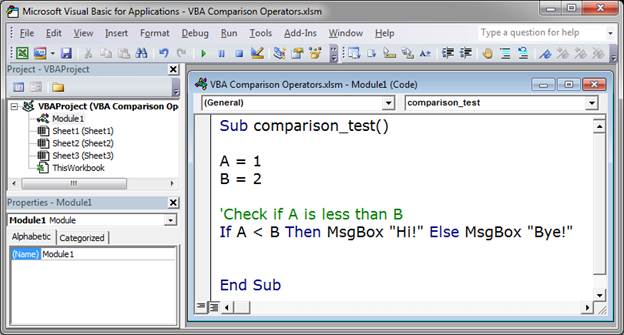
A < B
If A is less than B.
If A < B Then MsgBox "Hi!" Else MsgBox "Bye!"
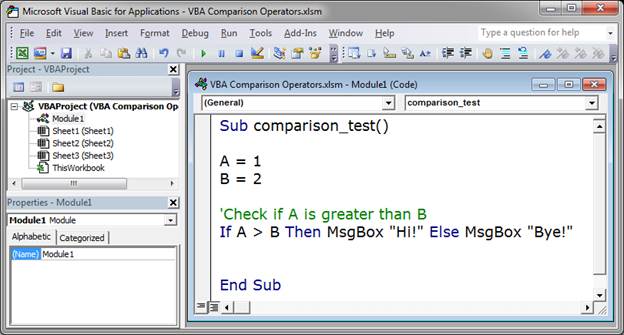
A > B
If A is greater than B.
If A > B Then MsgBox "Hi!" Else MsgBox "Bye!"
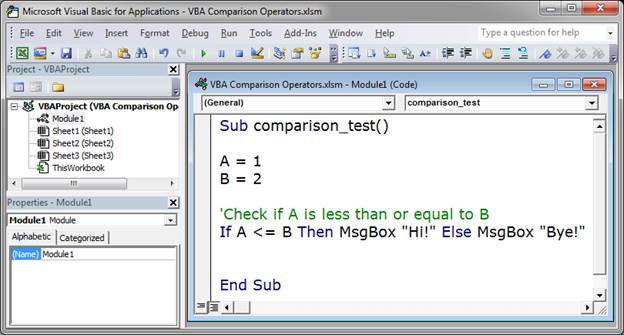
A <= B
If A is less than or equal to B.
If A <= B Then MsgBox "Hi!" Else MsgBox "Bye!"
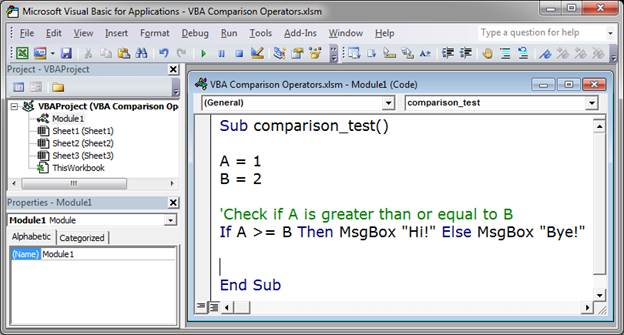
A >= B
If A is greater than or equal to B.
If A >= B Then MsgBox "Hi!" Else MsgBox "Bye!"
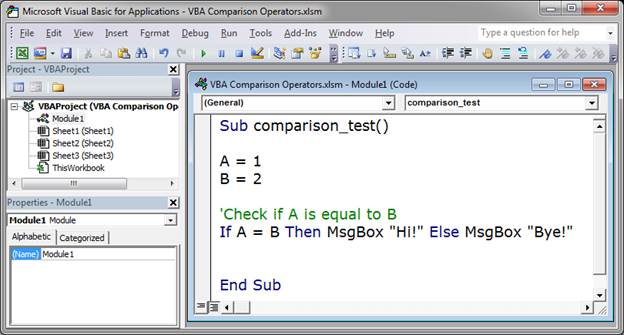
A = B
If A is equal to B.
If A = B Then MsgBox "Hi!" Else MsgBox "Bye!"
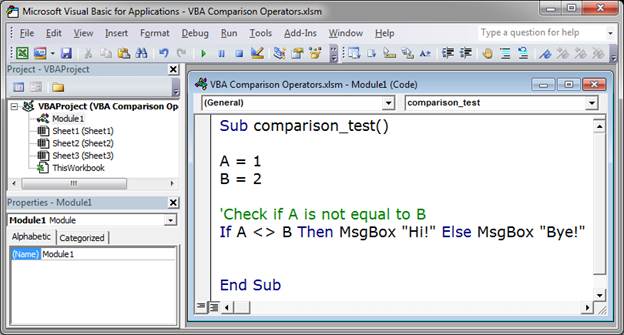
A <> B
If A is not equal to B.
If A <> B Then MsgBox "Hi!" Else MsgBox "Bye!"
Notes
Comparison operators are pretty straightforward but it does take a little time to get used to using them.
Bookmark this guide for future reference.
Download the file attached to this tutorial for the VBA code in Excel.
Question? Ask it in our Excel Forum

Excel VBA Course - From Beginner to Expert
200+ Video Lessons 50+ Hours of Instruction 200+ Excel Guides
Become a master of VBA and Macros in Excel and learn how to automate all of your tasks in Excel with this online course. (No VBA experience required.)
Tutorial: (Video tutorial's page: Compare Values in Excel - Beginner to Advanced) Logical compariso...
Tutorial: IF statements allow you to make decisions in your Macros and VBA in Excel. An IF statement...
Tutorial: The SUMIF function allows you to sum values based on a single criteria. This function wor...
Tutorial: Logical operators in VBA allow you to make decisions when certain conditions are met. They...
Tutorial: How to use parentheses in Excel in order to create more powerful formulas and functions. S...
Tutorial: The SUMIFS function allows you to sum values that meet multiple criteria across multiple ...
Subscribe for Weekly Tutorials
BONUS: subscribe now to download our Top Tutorials Ebook!

Excel VBA Course - From Beginner to Expert
200+ Video Lessons
50+ Hours of Video
200+ Excel Guides
Become a master of VBA and Macros in Excel and learn how to automate all of your tasks in Excel with this online course. (No VBA experience required.)